Hot ImagesHot ImagesHot ImagesHot ImagesHot Images
Showing posts with label Egypt riots. Show all posts

December 1, 2011

"Cyclones of Struggle: From Occupation to Intifada" by the Moment of Insurrection


A beautiful storm has come, but not yet the beautiful destruction”. The cyclone of intifada continues to destroy the Egyptian state, “I am boycotting because I believe it is a circus,” said rebel-blogger Hossam el-Hamalawy, “You cannot have clean elections while the police force which has not been purged is in charge of securing the ballot boxes. You have to settle the battle in the streets, then you settle it in the ballot boxes. We have to win our occupation in Tahrir Square first.”
The street opens itself to the community-in-motion as a parallel space against the state from which the emergent counter-power reproduces new ways of thinking and acting.
The battle of Tahrir is diffused throughout society this last year. Escaping reification into the political apparatus of capture, it exists as a Popular Power in the Streets. Over the last week it has manifest as violent insurrection in the district surrounding Tahrir Square, the Muhammad Mahoud meidan, where I stayed months ago:
“The people in Muhammad Mahmoud are decidedly not revolutionaries, they are vandals,” a police captain insisted. When in Rome, do as the Vandals.
From the revolution to civil war- no longer revolutionaries but a new form of life escaping from the structures of civilization. “It’s a way of life. You don’t just become one. You aren’t converted. You have to be an Ultra from within,” said Ahmed, a Cairo native and Ultra member who only agreed to an interview if his real name and appearance were not revealed.  The Ultras are “anti-media,” according to Ahmed. He said they prefer to keep their identities secret.
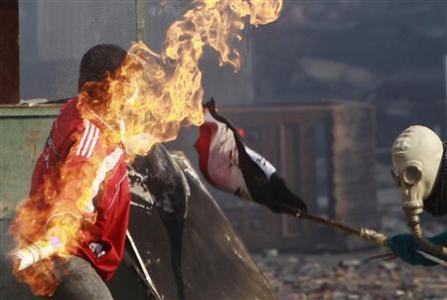
‘Ultra’. Who the fuck are these guys. “The Ultras have stood at the forefront of recent clashes with security forces. In many cases, they were armed with rocks, petrol bombs and firecrackers.” A fraternal organization of mad bombers.
“The Ultras are here. I know that because they’re the only ones facing the CSF (police) with force while singing their hymns,” protester Mosa’ab Elshamy wrote on Twitter on the first day of last weeks clashes. It is part of the Ultras code to remain anonymous to non-members. Dressed in a uniform of skinny jeans, neck scarves and hooded sweatshirts pulled tight over their heads, the Ultras in Tahrir could go unnoticed.
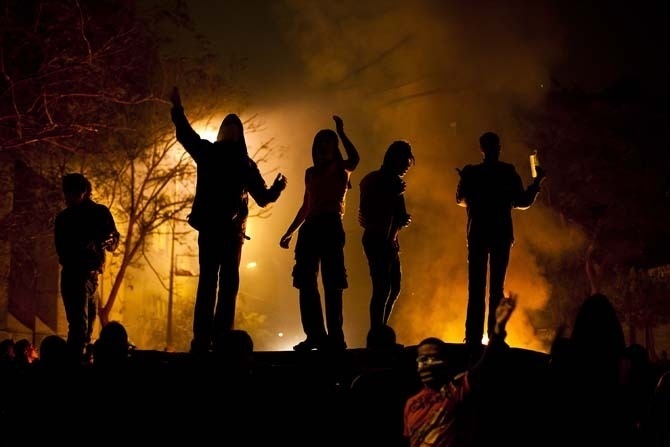
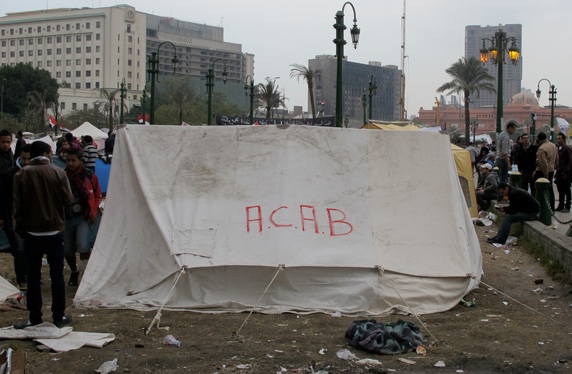
They are here now. Stepping out from the blaze of their flares. Constitutive of the ongoing occupation, their camp is set apart by hastily sketched graffiti on the tents that proclaims their beliefs for those who know the code.
“A-C-A-B,” Ahmed said, reading aloud the red etchings on the outside of his tent. “All cops are bastards,” he explained. According to Ahmed, the abbreviation is a motto for Ultras clubs around the world.  Ultra clubs, and the rest of us.
According to the blog, The Turbulent World of Middle East Soccer:
“Established in 2007, the ultras — modelled on Italy’s autonomous, often violent fan clubs – have since proven their metal in past confrontations with the Egyptian police, who charge that criminals and terrorists populate their ranks.

The ultras key role in the rebellion extends a tradition of soccer’s close association with politics in Egypt dating back to when the then British colonial power introduced the game to the North African country in the early 20th century. “
Out of the scene and into the streets! “Before the revolution the Ultras were confined to stadiums, so people didn’t know much about them,” occupier Elshamy said.
“After the revolution a lot of perspectives changed about them and they became really popular. They were described as those courageous guys. They stayed there in the square almost through 100 hours of fighting; It’s easy to notice them because of their use of Molotov cocktails, their extreme courage and recklessness, their chants. They became a common sight.”
Says an El Ahly ultra: “You don’t change things in Egypt talking about politics. We’re not political, the government knows that and has to deal with us,”
Rabab El-Mahdi calls this “clear class confrontations”. “Since the Ultras were created, they were always targeted by state security. They are seen as a mob or as hooligans,” she continues, “So they developed skills that none of the middle class was forced to develop. Plus they come from backgrounds where such skills are needed on daily basis just as survival mechanisms.”
She added that as long as Egypt’s security apparatus remained intact, violent confrontations would continue. “The skills they developed in dealing with police came in very handy and it comes in handy every time there is a direct confrontation,”
The ultras’ experience is also reflected in the setting up of survival services for the mass of protesters camped on the square in tents behind barricades and the introduction of a rotation of labour among them.
“There were designated rock hurlers, specialists in turning over and torching vehicles for defensive purposes and a machine like quartermaster crew delivering projectiles like clockwork on a cardboard platters.”
Ultras member Ahmed is careful to explain that he and his “brothers in blood” do not attack first. “An Ultra doesn’t attack anyone, We’re a watchdog for the truth. Any unfairness that we spot, within the state or anywhere, we have to stand up for what is right.”
“We don’t have any political direction. Whenever we go to a strike or a demonstration, we do it on an individual basis. We don’t announce it. We are just here as humans. On Saturday, initially we came individually. But then we found because we have similar beliefs we went straight to the front line and there were our brothers to the left and right. The personality of an Ultra places you at the front line because you are defending a cause. There is nothing easy in life, we have to suffer and sacrifice until we achieve.”
While ultras’ Power-Knowledge helped substantially in articulating and holding the front line, the front line was made of many other youths who carried on the fight. Some were young Islamists, refusing to obey their official party line. But the majority of front line fighters came from the substantial population of young, socially excluded men from Cairo’s peripheral ‘ashwa’i ["informal"] neighbourhoods. They are sometimes called the wilad sis.
The wilad sis are young working class men who might be described as precarious workers, most are unemployed, underemployed, unskilled and semi-skilled, doing occasional jobs that change every day (though on most days, there is no “work”).  Others refuse work and subsist upon the black market. They are often marked by a particular dress code and hairstyle that often involves copious quantities of gel (the word sis alludes to the attention they often pay to their appearance).
Earlier this year I traveled through Tunisia, Cairo and in Alexandria I met, over much hash, with a group of young insurgents who identified themselves as ‘Franco Arabia’s’. They celebrated a pan- Mediterranean, as expressed in a unique style of hip-hop and aggressive migration to Italy, a proclivity towards anarchism, queer liberation and are combatively against patriarchy
Proudly they told me it was their call for a day of action against the police- who had killed one of their comrades, which helped instigate the insurrection. The day of action was organized for Jan 25th- the national day of police, and after its announcement on face book, Tunisia exploded and the antagonisms in Alexandria and across Egypt did as well, until finally on that day, the demonstration led millions onto the streets which they violently held for weeks.
From the various field reports that I salvaged these quotes from, there is recognition of the middle class activists (as well as Islamist youths), most who expressed the understanding that without the barricades and violent resistance they would not have been able to protest. But no interviews for this montage. I will though, share this observation from Lucie Ryzova, an engaged-blogger during this last battle:
“It is in Abdeen, the streets east of Tahrir Square between Muhammad Mahmoud Street and Meidan Bab al-Luq, leading to the ministry of interior, where a battle was waged during the past week.
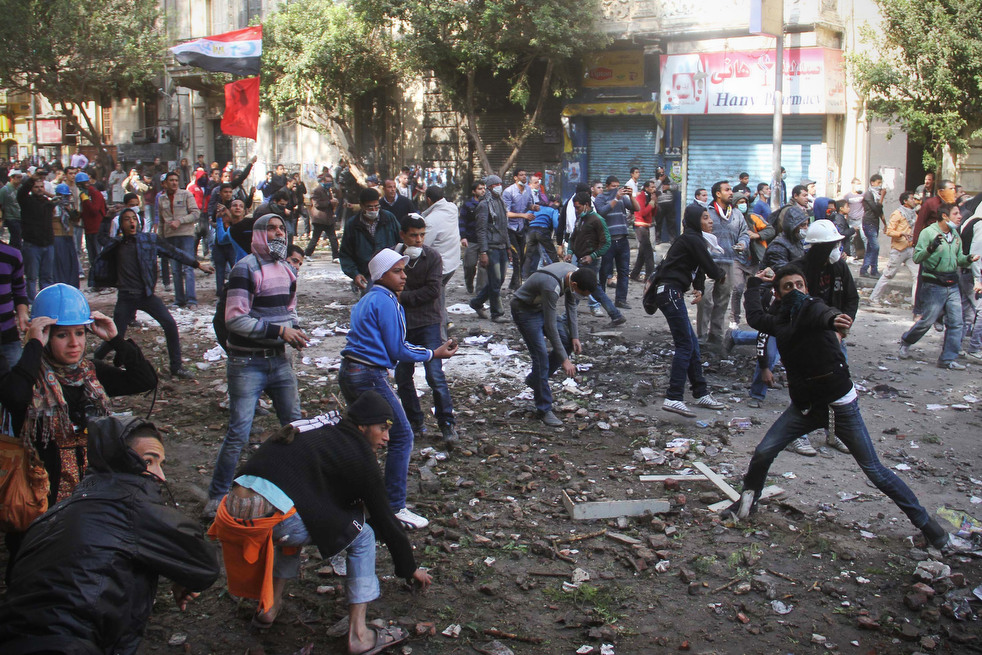
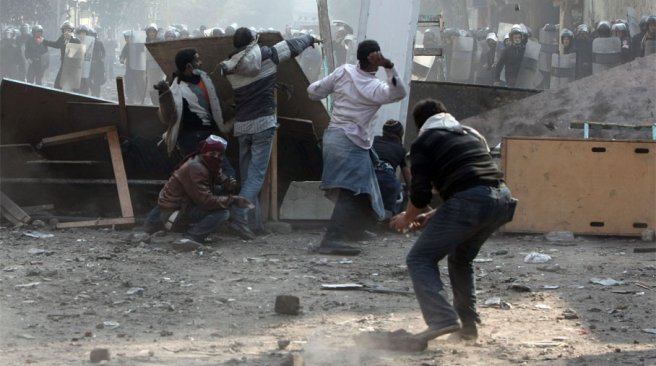
And a battle it was. People went there knowing what they were getting into. They went there to fight. Police threw teargas canisters and used shotguns (occasionally also live ammunition); against them was a line of young men mostly throwing stones, but also Molotov cocktails and small homemade bombs.
It was a “battle for the dakhiliyya ['the Ministry of Interior']“, but that does not mean that any of the young men facing the police necessarily wanted or intended to take over the ministry’s building. It was a symbolic battle – or more precisely, a frighteningly real and bloody fight over a symbolic location; the fight itself was the message.
The khatt al-nar ["firing line"] belonged to particular people who went there to beat and get beaten. Throughout the first week of the Second Revolution, Tahrir Square and the battlezone to its east each had its own demographic.
Each was a different crowd, but they can only be understood as a symbiosis – a specific social alliance – as both constructed and supported each other, and they increasingly overlapped. The square, the “safe” zone, contained a truly socially mixed crowd. People from all walks of life came there, often several times a day, in support of those who decided to camp out, to help “hold” the square and support its cause.
One saw a social mix rarely seen in Egypt (though it was famously present in the First Revolution): middle-class men and women, some of them activists but most of them not; young and old, in suits, kefiyehs and jeans, alongside the galabiyas and long beards of the salafis; bareheaded women as well as munaqqabat (fully veiled women).
On the front line, by contrast (and naturally so given the nature of the battle), the demographic was predominantly (though not exclusively) young male and socially marginal.
But the frontline and the Meidan are also part of one whole. The frontline’s position is to protect the Meidan, even if it also developed into a fight for its own sake. Without the on-the-ground crowd of ultras and the wilad sis prepared to stop police violence with their own bodies, and most importantly, to hit back, the largely middle-class opposition could not have held the Meidan for long.”
Was this violent defence not also the case for Occupy Vancouver? As made clear by Zig-Zag, it was the fear of the chaos brought forth in the 2011 riots that forced the city to keep their pigs on a leash. Anyone who was present at both riot and occupation know the difference was not only the communication of destruction- but also the communication of Counter Power.
The insurrections last year that has created this global intifada, was the becoming of a new solidarity between the pro-revolutionary’s and the rioting hoodlums. Such commonality was developed over years of relationships initiated by a militant underground group in Tunisia called Takriz, (its closest translations is, ‘breaking my balls’ or ‘bollocks to that’)
Realizing the advantage in working with Ultras as opposed to the same-old leftist shit- over several seasons they developed a Web forum for Ultras from different teams, hosted by Takriz. This allowed for years of mutual agitation, so that come the rupture is was a lightning transition from riot to insurrection
The ultras were also on Egypt’s streets at first crack. On January 24, the day before thousands planned to protest the Mubarak regime, the Ultra Facebook pages sent out a message saying, “We’re not political, we’re not part of this as an organization—you as individuals are free to do whatever you want (…) This is what we’ve been preparing for.”
There were also e-mails with attachments describing how to deal with the military—”an Ultra thing from Tunisia,” remembers Kotb Hassaneen, an Alexandrian insurgent. Some of the tactics they shared, says Foetus, the codename for a member of Takriz,  “have roots in long-standing contacts with anarchist and international protest groups like Indymedia, the Antifascist Network, and CrimethInc. For example, the technique called “Black Bloc”—having protesters wear black clothing en masse for impact and anonymity, with padding and protection to reduce injuries—dates back to 1980 in Germany.”
Here, the potentiality of a becoming-together of the spirit of the Riot and the antagonisms of the Occupation remain an open chance for us- in this Global Intifada.
The cyclones of struggle blast this world apart. Although there are periods that the state of siege regains the social peace- any moment that will explode, and again the streets will fill with fire. In this epoch we cannot allow the memory of the dead to be stolen. We stand as the Mothers of the martyrs who hold vigil in the midst of street battles.
Over the last year the insurrection has not ceased in Egypt or Tunisia, overcoming the billions of dollars empire spends (Canada $20 million) on counter-insurgency- in the form on elections and ‘democratic-institution building’. This apparatus of capture is the same network of regulation we battle here.  The institutionalization of crisis is best dealt with by the methods deployed throughout the ‘Arab spring’- that is, the absolute destruction of institutions and the armed exodus from the reifying radiation left in their wake. In Tunisia and Egypt I was witness to the ‘fired’ shells of bureaucratic control. The revolted will not trade in their looted weapons (93 cop shops and over 300 military barracks sacked in Egypt alone) for the opportunity to vote. And they have not abandoned the struggle against imperial democracy.
Almost everyone I met over there, I asked, ‘what will you do when the state steals your revolution?’ The unanimous response was, ‘We will just have another one’! Last month in Sidi Bouzid, the town from where the uprising in Tunisia began, the multitude set fire to the headquarters of the winning political party, the day after the election. Such will the beautiful destruction be wrought.

d.

Links to my travel writing & chronology of insurrections in Tunisia and Egypt:
http://momentofinsurrection.wordpress.com/fragments-of-intifada-in-tunis-egypt/
http://momentofinsurrection.wordpress.com/chronolgy-of-intifada-in-tunisia-egypt/

March 10, 2011

"Egypt Today, Tommorow the World", an analysis from Crimethinc ex Workers Collective


North Africa is in revolt. As usual, the most striking thing is how familiar everything is: the young man with the prestigious degree working at a coffee shop, the unemployment and bitterness, the protests set off by police brutality—for police are to the unemployed what bosses are to workers. These details cue us in that what is happening in Egypt is not part of another world, but very much part of our own. There are no exotic overseas revolutions in the 21st century. Make no mistake—though these events dwarf the riots in Greece and the student movement in England, they spring from the same source.
To keep up with events, we urge you to read our comrades’ dispatches from Egypt and anti-authoritarian perspectives from the Middle East in general. But for these uprisings to offer any hope, we have to understand ourselves as part of them, and think and act accordingly. To that end, we’ve solicited this analysis from a comrade in North Africa.

The Revolution in Egypt: 

The End of the New Pharaohs?

Ex-dictator Ben Ali flees in his private jet from crowds chanting for regime change—the hated Egyptian police stations long used for torture in the name of “anti-terrorism” are burned down—men and women armed with kitchen knives organize neighborhood self-defense against the police—the army refuses to fire on their families in the streets. 

What is happening—first in Tunisia and now in Egypt—is the beginning of the wave of full-scale revolutions that will inevitably follow the global financial crisis of 2008. Taking place in the wake of the failed “War on Terror,” these revolutions combine the latent force of massive numbers of unemployed youth with the dynamism of modern communication networks. They signal the conclusion of the decade of counter-revolution that followed September 11, 2001. Although they continue the exploration of new technologies and decentralized forms of organization initiated by the anti-globalization movement, the form and scale of these new revolutions is unprecedented. Largely anonymous groups are using the ubiquitous World Wide Web to spark leaderless rebellions against the pharaohs of the global empire of capital.
The self-styled rulers of the world are truly at a loss as to how to understand the new social and technological forces at play; the aging dictator Mubarak is a perfect example of this, but he is hardly the only one of his kind. One can almost smell the fear, not only amongst the despots of China and Saudi Arabia but also the supposed leaders of representative democracies. The contortions the US government has been going through are the most grotesque of all; it isn’t lost on the Egyptian people that the bullets striking down their comrades came from the USA. Egypt receives $1.3 billion dollars of military aid from the US every year. The suppression of “democracy” in the Middle East has been a deliberate policy of the US government: they know popular sentiment would never support their agenda as the military enforcement of global capitalism.
The best efforts of Mubarak’s dying regime to put its fingers in the ears of the world have not silenced the people on the streets of Cairo. Even blocking cell phones and trying to turn off the entire Internet have proved futile. For generations, Arabs and Africans have been silenced, represented by various colonial governments and portrayed as “primitive” and “terrorist” in Europe and the US. Now the people of Egypt are speaking in thunderous unison for freedom—not for political Islam, as demagogues from Iran to Israel would have the world believe. In doing so, they are realizing the ideals to which the US government pays only hypocritical lip service.
Today, the common condition from Egypt to Tunisia is approaching universal unemployment—especially among the younger generations, which comprise the vast majority of population. This is increasingly the case in the United States and Europe as well. Unemployment is no accident, but the inevitable result of the last thirty years of capitalism. Capitalism reached its internal limits at the end of the 1970s; now the factories of every industry produce ever more commodities, while increasing automation renders workers less and less necessary. The only way to make profits off these commodities is to eliminate workers or pay them next to nothing. To discipline the skyrocketing unemployed population and prevent revolt, the police wage a never-ending war on the population. We live in a world overflowing with cheap shit, in which human life is the cheapest of all.
In these conditions, people have nothing to left to lose. Nothing, that is, but their dignity—and it turns out they will not surrender that. It was precisely this innermost core of dignity that led Mohammed Bouazizi to light himself on fire rather than face humiliation at the hands of the police, who in seizing his fruit-selling cart took away the only way he could feed his family. The blaze lit by Mohammed Bouazizi has spread, carried by other unemployed people who thereby transform themselves from abject beggars into world-historical heroes. The people of Egypt are not only burning police cars, they are organizing popular committees to clean the police and other trash off the street, and the streets of Cairo have never felt safer.


It is not surprising that a wave of revolutions should begin now. Not since the days of pharaohs and monarchs has the world been controlled by as senseless a force as the global financial market. As capitalists became less and less able to produce profit from industrial production over the past decades, they had to invent means of profiting based on expected future returns. But in a world of increasingly cheap commodities and poor consumers, how could capitalists keep people buying stuff and still make a profit? They had to invent a way for consumers to continue buying even when they weren’t paid living wages: thus the invention of mass debt. When the sale of real goods can no longer produce profit, profits must be made on increasingly fantastic expected future returns—in other words, on finance.

Yet like any house of cards, debt cannot be built up forever. Eventually, someone wants to be paid back—and so the entire house of cards collapsed under its own weight in 2008. The financial crisis signals a deeper metaphysical crisis of our present order: capitalism is unable to provide for the real material needs of the global population. The high poverty rates in Egypt are not simply the result of mismanagement by Mubarak, but the inevitable consequence of the contradictions of our era.
Their eyes hopelessly clouded by their own ideology and lack of vision, heads of state can only stand dumb and surprised as the crisis goes on and on. They lamely hope to re-start the financial markets through “austerity” or “green” capitalism, refusing to consider systemic change despite the fact that the system cannot even deliver jobs and affordable commodities to people—much less a good life. Just as it took an era of revolution to overthrow the divine right of kings, it will take new revolutions to overthrow the divine right of things: the power of financial capital and its puppet dictators.
Revolutions are never brought about by technology, but rather by the collective action of human beings who radically transform their relationships with each other and the world they share. However, one cannot deny what an important role the World Wide Web has played in Egypt and Tunisia. Especially among cybernetically skilled and predominantly unemployed youth, it enabled people to call for and participate in mass mobilizations without any need of leaders. The demonstrations in Egypt on January 25 were called for by a Facebook page called “We Are All Khaled Said,” named for a victim of police brutality much like Alexis Grigoropoulos in Greece. The page itself was set up by the anonymous “El-Shaheed”—that is, “martyr” in Arabic. Meanwhile, youth throughout the world are mobilizing as Anonymous; in the battle over Wikileaksactions against the Tunisian government, Anonymous has showed itself to be a potent new international with an awakening political maturity beyond the message boards of 4chan. Demonstrators’ ability to communicate with large numbers of people and react immediately to events via mobile phones, Twitter, and Facebook is swiftly making previous forms of Leftist and industrial-based political organization obsolete, along with other hierarchical formations such as political Islam. and more recently in
This revolutionary use of social media should come as no surprise. In the hands of an elite few, expensive communications technology will naturally be used for self-aggrandizement and consumerism. In the hands of unemployed youth and other excluded classes, this technology can be re-purposed to organize revolution. The Internet is the new global factory floor, and we are seeing its first workers’ councils form—a new kind of collective intelligence that enables people to organize themselves directly without representation.
The blank confusion of global capitalists as to who is “really behind” the mysterious resistance in Egypt and Tunisia is revealing. It’s obvious how desperately US politicians wish they had anyone, such as Mohamad ElBaradei, with whom to negotiate. These revolts are anarchist in form if not content—and even the content is becoming increasingly radical. The absence of any organized group or leader in the early days of the protests speaks volumes: increased information technology has not only destabilized the old Leftist forms of organizing, but also the justifications for having hierarchical government in the first place. When people can communicate, they can organize their own lives. Expanding such horizontal structures to a global scale no longer seems impossible, even if it is not yet well thought out.
To make things even worse for capitalists and nation-states, the massive secret apparatus of the state has been revealed in all its incompetence by sites such as Wikileaks. While Wikileaks had nothing to do with the Egyptian revolution, the cables describing Ben Ali’s pet tiger being fed a luxurious diet while Tunisians starved further stoked the flames in that country. Wikileaks has produced paranoia in the global state apparatus itself, as the state cannot function without the subjugated population believing that it is necessary and according it the right to exercise violent force. Now the empire has no clothes—and its naked corrupt power is disgusting to behold. There is a growing consensus that the state apparatus is an archaic holdover no longer worthy of respect.
The Mubarak regime made the classic mistake of conflating technological structures with the people using them, an error typical of Silicon Valley and certain theorists as well. In a poorly thought-out move, the regime shut down all four ISPs in the country, effectively turning off the Internet. In addition, cell phones have been intermittently blocked before major demonstrations. If anything this only enraged the Egyptian people more. It may even have interrupted their spectatorship—it is easier to watch a demonstration over the Net than to participate—and driven more and more people into the street.
The lesson here is clear: the supposedly decentralized Internet is quite centralized, and while it may be useful, it is a mistake to depend on it as long as it remains in capitalist hands. Yet rulers such as Mubarak face a no-win situation. If they keep communications technologies up and running, these will be used to organize against them—but if they take them down, it will provoke worldwide outrage.

How do you organize without the Net? You might start with existing social institutions; in Egypt, this meant the mosques. The “Days of Wrath,” characterized by street-fighting with the police far more intense than the Greek insurrection of 2008, culminated in the torching of the headquarters of Mubarak’s party. Afterwards, in a brilliant move, the protesters called for people to gather after prayer at mosques—where most Egyptians would be gathered anyway. In this regard, the mosques served the same purpose that social centers and squats did during the Greek insurrection, only for a much greater part of the population.
So while communications technology may be advantageous in the early stages of organizing, a movement must become powerful enough not to need the Internet once it takes to the streets. In Egypt, the revolt actually grew in intensity after the Internet was shut off.
If there is one regard in which the Internet is indispensable, it is in spreading the news of disorder elsewhere. As the Empire’s power has become increasingly spectacular, it has become more vulnerable to being damaged on the terrain of the spectacular. Obama’s first response to the uprising was to call for the “violence” to cease—even though his government routinely administers violence in Pakistan and Afghanistan and inflicts it on US citizens through the world’s largest prison system. He and Mubarak are not against violence, but they appear to be afraid of images of violence. If these images escape, they undermine the state’s cover story about maintaining order.
At the same time, the state desperately needs people to distrust and fear each other. This explains why Mubarak released undercover police in civilian uniforms to pose as looters in order to justify his crackdown. When that failed, he turned off the Internet and denied media access in order to prepare the conditions for the kind of massacre it would take to restore his control. Yet now it seems doubtful that the army is willing to carry out such a massacre.
The insurrection that began by burning down police stations then shifted to massive peaceful demonstrations intended to win over the army. Pamphlets that have circulated indicate that Egyptian organizers planned from the beginning to pit the army against the police. Insurrectionists in Europe and the USA should take note of this clever strategic move. After the front line of the party of order was effectively defeated, the Egyptians clearly understood that the only force capable of stopping them was the army. Instead of attacking it directly, which would surely have resulted in a massacre, they undertook to win over the hearts and minds of the soldiers. Thus far they have been successful in this, demonstrating that they can self-organize and maintain a leaderless yet disciplined rebellion that makes the streets of Cairo safe and clean for the first time in years.
This leaves the army without a reason for existence, let alone any excuse for a massacre. Once an insurrection has reached a certain phase, as a friend has said, weapons are unnecessary. For a revolution to succeed in overthrowing the state, the army must refuse to shoot its own people and instead join them in revolt. In Egypt, the army is at least paralyzed enough right now not to start shooting; it may yet join the people, or more likely attempt to broker a transition to representative democracy.
All this shows that billions of dollars of military equipment can’t stop a revolution. Once things reach a certain point, military force is no longer the determinant factor. If the Egyptian people persist in revolt, the military can hardly bomb its own cities.
Yet even if a military defeat is avoided, the insurrectionary process begun on the “Days of Wrath” is more likely to be side-tracked into representative democracy than to end in a genuine communization of society—that is, in the immediate sharing of all production for the survival of the people. This is not to be pessimistic—already the neighborhood assemblies and defense committees resemble nothing more than the Paris Commune. But Mubarak is a dictator, and the youth of Egypt have not yet tasted the bitter fruits of representative democracy. They may have to learn about them the hard way. Even if a representative democracy is established, it will not be the end of the story—witness the continuing protests in Tunisia. There would inevitably be another insurrection sooner or later, although that could take years or decades.
In this context, it is promising that many young Egyptians seem aware that representative democracy will only limit their movement and redirect into yet another form of enslavement. This is visible in many ways—for example, in the message sent to self-appointed leaders like ElBaradei, “Shall we just call your mobile when we have finished the revolution for you?” The insurrection has also seen unparalleled action and power of the Egyptian women, who will not go back to being subservient under the Muslim Brotherhood after these upheavals.


Yet the popular occupation of Tahir Square cannot last forever; there must come a moment when food will be produced, train lines reactivated, and the Internet turned back on. These are the real keys to the success of the insurrection and to preventing the return to capitalism, even under the mantle of representative democracy. It seems that the steps in this direction have not yet begun.

Let’s step back now and ask larger questions. If Egypt is not fundamentally different from Europe and the US, why haven’t such insurrections happened there as well? First, let us not be too hasty—the dominos are already falling, with massive protests in the streets of Jordan, Algeria, Yemen, and Mauritania. One reason the insurrection has such popular power in Egypt is that, as many Arabic-speaking countries, the Egyptian form of life has not yet been fully subsumed into capitalism. For example, in many cases one only pays as much as “one feels” one should pay for goods. Haggling is not so much a way to maximize micro-profits as to ascertain an affordable and ethical price for an exchange. The commodity exchange itself is often less important than the social relationships that the commodity symbolizes. The collective responsibility and power of the family knits people together over generations, in contrast to the alienated individuals of the United States and most of Europe. The vibrant and public street life of the Middle East is a natural fomenting ground for insurrection.
Yet are there not dark forces waiting in the wings? This seems unlikely, as the protest is clearly focused on “freedom” rather than Islam, with those wanting to lead religious chants being shouted down on occasion. This is not to say that Egyptians are not Islamic—indeed they are—yet there are subtle distinctions. Political Islam is effectively the Tea Party of Egypt, a hierarchical religious movement mostly of the older and conservative generation; but Islam exists in other variants, binding social relationships and promoting a collective ethics. One can even interpret the giving of alms in Islam as a ritual to avoid excessive centralization of wealth. “Allah” does not necessarily denote a commanding deity; the notion may also point to the ineffable, the invisible excess of life that denies reduction and resists the catastrophic harnessing of all to the imperatives of profit.
Of course, currents far older than Islam hold sway in Egypt as well. Unlike many in Europe and America, many Egyptians are profoundly aware of their history from antiquity onwards, and feel deep shame at their present state of impoverishment. The dignity and respect they show each other in the streets in midst of the insurrection attests that this revolution is not abstract, but rooted in everyday lives; it is the deep metaphysics of these forms of life that provide the subjective conditions for transformation.
Communism is older than Marx, just as anarchy is older than Proudhon. The age of revolutions did not begin with the Paris Commune, nor did it end with the fall of the Berlin Wall. As capitalism now encircles the earth, the one thing that could unite the world would be a common rejection of it and the police that defend it. The communism of Marx was trapped in the abstract metaphysics of economics and poisoned by a misunderstanding of the danger posed by the state; this sabotaged the revolutions of the early 20th century, bringing about the catastrophe of Soviet-era state capitalism.
But the age of revolutions is not over; on the contrary. In a song of the Tuareg—“the desert is our mother, and we will not sell her”—we can glimpse a form of communism far more alien and hostile to capital than anything imagined by Lenin. Many of the calls for “freedom” in Egypt have little to do with the freedom to elect a president or choose among commodities on the market, but resonate with a common desire to live with their heads high and not cowed to any ruler. For this they are ready to die, whether by self-immolation or in the streets together.
Yet one can sense a profound need at this time for a common international revolutionary purpose that resonates outside of the Middle East, for something truly universal to fill the void left by capitalism. The nationalist flags of the protesters were tactically effective at confusing the army, but they also reflect a lack of critique of the conceptual apparatus of capital and the state. While the conditions are right for revolution, over the last thirty years revolutionaries have largely failed to create and spread the organization and analysis necessary for insurrections to become genuine anti-capitalist revolutions. What does it take for people to realize that the true potential of their neighborhood defense committees is not as a means of temporarily replacing the police, but of prefiguring the abolition of all police, in every country?
No event occurs in a vacuum; events originate in concrete conditions, and consequently they tend to come in waves. The events in Egypt show that the center of revolutionary impetus is no longer “the West”; this new age of revolution will culminate first in areas where the living conditions are becoming unbearable and the ways of life are not yet completely colonized by capital. However, it would be a mistake to see this as merely the conclusion of an unfinished anti-colonial revolt. It is something much bigger and deeper. The financial crisis is a sign that capitalism is on a declining trajectory. The conditions that precipitated the events in Egypt are rapidly becoming universal across the globe, spelling another cycle of revolution and possibly war. Eventually these same forces will hit Saudi Arabia, Europe, China, and finally even the United States with the strength of a tidal wave.


Make no mistake about it, we are entering an era of revolt. These revolts will reject and attack capitalism in their concrete practice, even if the systematic destruction of earlier revolutionary currents has left a vacuum. Hopefully the participants will realize that freedom is impossible without the destruction of capitalism and the state, and a new generation of revolutionary thought will update the concept of revolution for the dawning era. We are at a point now where it should become clear to all that we can direct our own lives—that the state is a historical fossil holding us back. As shown in Egypt, the stranglehold of the state and capitalism must be broken in the streets; over the coming decades the results of this ultimate struggle will likely decide the fate of humanity itself.
All Power to the People!
-A dissident exiled in North Africa
with assistance from the CrimethInc. Workers’ Collective

February 3, 2011

News From Egypt / a blog written during the revolt of Egypt in Cairo Now! News from riots in Egypt here and now


Revolution People!Revolution!


"The People Wants to bring Down the Regime"


Void Network hosts here the link of a fine blog written directly in Cairo and trying to spread news and opinions from Egypt underground to the insurrectionists and people from all over the world who express solidarity to the struggle of Egyptian people.


This blog is a collection of comments, contributions and visual media from the Egyptian uprising. It is sent out from one of the few locations in Cairo with an internet connection. Mubarak’s regime cut the internet to the country ahead of a call for a day of rage. The consequences of this day have gone beyond any expectations.
“The people want to bring down the regime” has become the most common chant on the streets.

please use the contact of the blog or the email
voidinternational@gmail.com
to send reports, news, opinions and messages of solidarity to the Egyptian people who struggle for
Total Freedom, a freedom that goes beyond the limitations of state, religion, class, gender, race or ethnicity


Related Posts Plugin for WordPress, Blogger...