Hot ImagesHot ImagesHot ImagesHot ImagesHot Images
Showing posts with label OCCUPY EVERYTHING. Show all posts

February 9, 2012

TAKE THE CITY! (What´s new in Spanish Revolution)


Hi comrades!

We write you to spread a Spanish´ (Mallorca) iniciative called "take the town" (tomalaciudad). It´s about take empty places (private or statal properties) and make them squares, communitary gardens, places to meet each other and work togeter (Exarhia´s way).

It is a political action based in assamblies, a critic of urban design, building a common space for the people.

Sorry my english is not enough to describe but this is the video with english subtitles and this is the manifest

Hope you like it. We ask you to make diffusion.


TAKE THE CITY!

It has been a long time decisions are taken for us but without us.
Once upon a time, there were collective spaces where people lived together and took decisions amongst equals, cultivated dialogue, fraternal cooperation and work for the common benefit.
Nowadays, our lives have been mortgaged to a political and economical system that has impoverished us and made us more dependent.
They called the political irresponsibility of putting in someone else’s hands the affairs that matter to us “freedom”.
We were educated within a childish and selfish outlook, articulating society in closed compartments where ruthlessness and mistrust prevail, rather than collaboration and respect.
We were “the people” and they made us “the public”, we gave up being actors to become dejected spectators of a life managed from above.
The design of our cities is also a purely political issue: the arrangement of gardens, fenced by barriers, closed by night; flowers lined up like paving stones, bushes pruned like walls.
Urban space was thought up for a mute transit of vehicles, persons and merchandising. The stage is sterile and the flow never stops - because, if we stop, order is in danger.
We have realized business and state production ways do not respond to either our wishes or our needs, and, instead, it generates corrupt and unjust structures and is hugely damaging for the environment.
What would happen if we started managing the world ourselves, from below, in a different way?
Let’s imagine, for instance, a transformed city, more natural, where, instead of so much tarmac, paving stones and sterile gardens, we grew aromatic herbs or plants from which we could extract natural remedies; where, instead of ornamental parks, we had orchards and ecological vegetable gardens, looked after by all together, children, grown ups, elders and youths.
What would happen if, instead of maintaining a highly expensive and often inefficient state public sector, we built a network of people’s services, autonomous, where the labour that supported it was managed by people’s assemblies and not according to the profit of a few; where each of us would contribute as we can and where we can; where we could develop in a wholly way as persons, both to give and to receive, not being mere passive consumers anymore?
It is not hard to imagine if we take into account that social state services are suffering ongoing cuts and the model of welfare state appears unviable, judging by the heavily indebted economical situation.
Today, our streets overflow with closed spaces: empty houses, unused plots, unfinished buildings. We start to see the ruins that reveal the decadent state of a society in crisis. A society that we do not choose but that we pay dearly.
Thus, we will take those unused spaces, previously usurped by the logics of private profit and public loss, giving them new uses for the benefit of all. So, we invite you all to participate into the new society we are constructing in those places.
We are not here to do abstract demands, it is not enough to be indignant, we are here to meet each other, populate a space and take life in our hands. We are the inhabitants, not mere passers-by, of a world that is our home, and it is our responsibility to build it.
Our strength will be measured by what we do, which, moreover, will be an example of what we are able to.
So, let’s do it, we shall not wait anymore.  


December 4, 2011

California Police Peace Officer Standards, Training Crowd Management and Civil Disobedience Guidelines / CROWD MANAGEMENT AND CIVIL DISOBEDIENCE GUIDELINES: shared by publicintelligence.net


Void Network invites the friends and comrades to read, investigate, think and understand the methodologies and practices that USA and European Police uses to manipulate, passify and desolve the crowds of horizontal, anti-hierarchical and revolted communities in the streets and occupied squares of this world. The research platform Public Intelligence host (among many others) the 

California Police Peace Officer Standards and Training Crowd Management and Civil Disobedience Guidelines

featuring


CROWD MANAGEMENT AND CIVIL DISOBEDIENCE GUIDELINES


  • 35 pages
  • March 2003

Download

Penal Code Section 13514.5 requires the Commission on Peace Officer Standards and Training to establish guidelines and training for law enforcement’s response to crowd management and civil disobedience.
These guidelines contain information for law enforcement agencies to consider when addressing the broad range of issues related to crowd management and civil disobedience. The guidelines do not constitute a policy, nor are they intended to establish a standard for any agency. The Commission is sensitive to the needs for agencies to have individualized policies that reflect concern for local issues. The Commission intends these guidelines to be a resource for law enforcement executives that will provide maximum discretion and flexibility in the development of individual agency policies.

In the United States all people have the right of free speech and assembly guaranteed by the First Amendment of the Federal Constitution and California State Constitution. Law enforcement recognizes the right of free speech and actively protects people exercising that right.
The rights all people have to march, demonstrate, protest, rally, or perform other First Amendment activities comes with the responsibility to not abuse or violate the civil and property rights of others. The responsibility of law enforcement is to protect the lives and property of all people. Law enforcement should not be biased by the opinions being expressed nor by the race, gender, sexual orientation, physical disabilities, appearances, or affiliation of anyone exercising his/her lawful First Amendment rights. Law enforcement personnel must have the integrity to keep personal, political or religious views from affecting their actions.
When it becomes necessary to control the actions of a crowd that constitutes an unlawful assembly, the commitment and responsibility of law enforcement is to control lawfully, efficiently, and with minimal impact upon the community. A variety of techniques and tactics may be necessary to resolve a civil disobedience incident. Only that force which is objectively reasonable may be used to arrest violators and restore order.
All agencies should familiarize themselves with the terms, definitions, and guidelines set forth in this document. These are the generally accepted principles by which agencies respond to lawful and unlawful assemblies. The material in this document is designed to assist law enforcement executives in addressing the broad range of issues surrounding civil disobedience.

Guideline #9: Use of Force: Force Options
Agencies should develop use of force policies, procedures, and training for managing crowds and civil disobedience.
Discussion:
When dealing with crowds and civil disobedience situations, law enforcement must be a disciplined and well-organized control force. The decisions to use force and the force options that may be applied in response to these incidents range from law enforcement presence to deadly force. Peace officers need not use the least intrusive force option, but only that force which is objectively reasonable under the totality of the circumstances (Scott v. Henrich, 39 F. 3d 912, 9th Cir. 1994, and Forrester v. City of San Diego, 25 F. 3d 804 9th Cir. 1994). Graham v. Connor, 490 U.S. 386, 109 S. Ct. 1865, 104 L. Ed. 2d 443 (1989). The reasonableness of the force used to affect a particular seizure is analyzed under the Fourth Amendment and determined by balancing the nature and quality of the intrusion on the individual’s Fourth Amendment interests against the governmental interests at stake.
Prior to an event, agencies should continually review their use of force alternatives in response to potential actions by protesters. Training should reflect reasonable use of force alternatives in order that officers are prepared to consider the tactics/force options available. Chew v. Gates, 27 F. 3d 1432, 1443 (9th Cir. 1994).
* A Sampling of Use of Force Considerations:
  • Determine compliance or non-compliance of crowd
  • Physically moving non-compliant offenders
  • Anticipate possible actions of demonstrators
  • Identify criminal violations involved
  • Develop arrest protocol
  • Develop use of pain compliance protocol
  • Plan for disabled, elderly, and children demonstrators
  • Determine availability of personnel
  • Evaluate availability of other public safety resources
  • Include protection devices for involved personnel
  • Plan for the safety of bystanders
  • Evaluate mobility of suspects/protestors
  • Determine avenues of controlled departure
  • Anticipate potential for medical resources
  • Establish protocols for less lethal munitions
* A Sampling of Force Options:
  • Law enforcement presence
  • Verbalization
  • Firm grip
  • Compliance techniques
  • Control devices
  • Nonlethal chemical agents
  • Electrical control devices
  • Impact weapons/batons
  • Less lethal (i.e., sting balls, grenades, bean bags)
  • Deadly force

 you can read more Police and State methodologies here:

Download

you can read more info from Public Intelligence here:
http://publicintelligence.net/

November 15, 2011

"All Power to the General Assemblies? Or, the Strange Case of Take Artists Space" by Trevor Owen Jones from ViewPoint Magazine


After the raid on Zuccotti Park early this morning [ http://www.nycga.net/ ], what remains of Occupy Wall Street? The library was destroyed and thrown in the garbage; the kitchen and commune that fed and housed hundreds now gone. But what about the general assembly?

The police violence demonstrates that the relevance of Occupy Wall Street as a political situation is by no means in its attempts, failures and very real successes at direct democracy. It is instead a question: what is beyond democracy in the spirit of Occupy Wall Street?

This is not some terrible, reactionary deconstruction of the importance of consensus, discussion, and the camaraderie of equals; I merely mean to pinpoint tactics of affinity that force platforms of sharing and leveling to occur in the first place. As Rosa Luxemburg [ http://www.marxists.org/archive/luxemburg/1918/russian-revolution/ch06.htm ] said,“freedom is always and exclusively freedom for the one who thinks differently” – to not discuss this, and bring it forthwith, is to say only endless opinions matter.

Why should mere “opinions” be interesting? Why should anything like Occupy Wall Street be supposed to be a monolith of practices and ideas? Even if it were, why should it continue as it is? The power of Occupy Wall Street is in its multiplicity of democratic forms, not endless rote assemblies. The recent raids on Oakland, Portland and New York (most likely coordinated) are forcing Occupy Wall Street to radicalize its formations – autonomous affinities are necessary to propel the “movement,” but in order to do this, they cannot be wholly identified with it.

At 5PM on Saturday, October 22, a group of activists, artists and others occupied Artists Space [ http://www.nytimes.com/2011/10/25/nyregion/occupy-wall-street-splinter-group-occupies-art-gallery.html ], a project of the New York State Council on the Arts which had the goal of assisting young and emerging artists. Deemed “Occupy 38” (for 38 Greene Street, Soho), over the course of the next 28 hours they drew dismissive comments, if not outright venom, from every would-be analyst of Occupy Wall Street. Village Voice feigned confusion. Anonymous decried it with “this ‘occupation’ sucks !!!” On Twitter, the hashtag #occupy38 was bizarrely filled with vitriol against the action, with numerous New York bloggers and journalists claiming understanding and sympathy with Occupy Wall Street at Zuccotti Park and the movement as a whole, but eager to denounce “Take Artists Space” as “immature” and “stupid.” Despite holding open general assemblies, Occupy 38 was quickly construed as “elitist.” Though they did not try to promote exclusivity, it is true that their goal was to circumvent the General Assembly – with its undercover cops, wet blanket liberals, and bleating obsessions with process – in order to advance the movement.

Trees for the Forest

Of course, those behind Take Artists Space were well aware of their actions – the committees and process of Zuccotti were becoming overwrought and stifling, and it was a necessity to take indoor space, especially before the cold weather began, to renew the radicality of OWS’s initial gestures. In other words, to continue a serial composition of what occupation is, not defensively and hysterically crying out “quid juris?” [ http://conservapedia.com/Questio_quid_juris ]

Occupying a more community-oriented art gallery was a calculation to avoid an immediate crackdown – Artists Space failed in this regard, eventually snitching on the occupiers, because by all anecdotal reports, they were, in summary, mean.

Why does any of this matter? The obvious response was included on the Take Artists Space tumblr [ http://artistsspaceoccupation.tumblr.com/ ]. They found themselves “amidst accusations of moral deficiency and political immaturity, the same accusations wielded by the owners of Zuccotti Park at the start of its occupation.” But this critique was unfortunately lost on the liberals of the blogosphere.

The liberals felt that Take Artists Space drew attention away from the main struggle of Occupy Wall Street and its Zuccotti Park origin story, implying that if the talisman of that place were to be taken away, the “movement” would somehow cease to grow. As though the power of the general assemblies were in their unity, and not their multiple elements! The occupations symbolically uphold their occupied spaces, but any aberration is deemed “poorly organized” adventurism by people who insist on symbols alone. The “friendly,” “radical” media relished in calling out the perceived turpitude and audacity of Take Artists Space, and effectively did the work of the police’s PR department.

But never mind that. Given the real arc of affairs supplying the backdrop to the drama that is OWS – the breakdown of global capitalism as a world system – why not support emancipatory revolt in all its forms? Given the very realistic long-term consequences of today’s events, why stunt the transformative potential of everything that emerges from capitalism’s structural contradictions?

The mistake today is to look at Greece, Spain, London, Chile, and elsewhere, and hold them in relief as parts of a whole, a single phenomenon. Actually, this is what a single phenemenon looks like as it is being ripped apart. We should participate in its coming apart – it’s not as if we could do anything to prevent it! Are there some people – even those who claim support for Occupy Wall Street – who still believe a return to the status quo is possible, but with maybe a little more democracy and jobs thrown in?

The general assemblies, while exciting and resonant, are not sacred cows. The general assemblies sustain a refusal of today’s dismal situation not only inasmuch they do just that – sustain the refusal. They must meet at the intersection of revolutionary sequence and insurrectionary act: where they are a process, they should also be an act of transgression, and where they are transgressive, they should also move toward a real goal. When they are neither, they should be scrapped for something else. They do not represent anyone, and do not speak for the movement, strictly because there is not a movement, but thousands of movements, in full floral bloom.

Still Not Getting It

Simply put, there isn’t any stopping what is under way – what is important is to foster the creation of groups, agitate and educate in and out of the workplace, and splinter whatever unity the present possesses into many other factions and affinities. Forcing encounters – those moments when business does not go as usual – is the prerogative for new assemblies and methods. Global capital preserves a situation in which there are no encounters, because business must always go as planned, and nothing exists but business. Take Artists Space was an attempt at creating an encounter – to draw out the consequences of haste and audacity, and adhering not to schisms in general, but to generating schism and playing it out until the music stops. If experimentation rubs people the wrong way when its happening, this is the symptom that something new is occurring.

The last communiqué from Occupy 38, or Take Artists Space [ http://artistsspaceoccupation.tumblr.com/post/11857646857/the-occupation-at-38-greene-street-ended-at-8pm-on ] , affirmatively reads,

We battle with saboteurs, camouflaged socialists, intellectual skepticism; and we say: Let’s occupy something else. Now we know who we can invite. The ones that don’t wish only for progress to our movement, but the efforts of our bodies to expose and threaten, to break structures and clichés which are not bound only in the arena of a bureaucratic village. In this process we are educated about tactics of friend and enemy.

It is Pollyannaish to continue to assume that everyone will be Occupy Wall Street’s friend, just as it is obtuse to believe there are enemies around every corner. We must continue to discover who our friends really are.

The first sequence of the Occupy movement, as events in Oakland and Chapel Hill attest, is over. On Take Artists Space tumblr log, the key to the action was in the language used: “Take That Which is Already Yours.” It’s impossible to “occupy” something that is already yours – but it must be taken back, indefinitely. Zuccotti Park and Oscar Grant Plaza must not be just “reoccupied” in response to this recent wave of state repression. They must be taken permanently. Now the real work begins. We must change the political situation. “Occupy Everything” is literal, and because of that, stop saying “Occupy.”


text first appeared in November 15, 2011 at ViewPoint Magazine


November 7, 2011

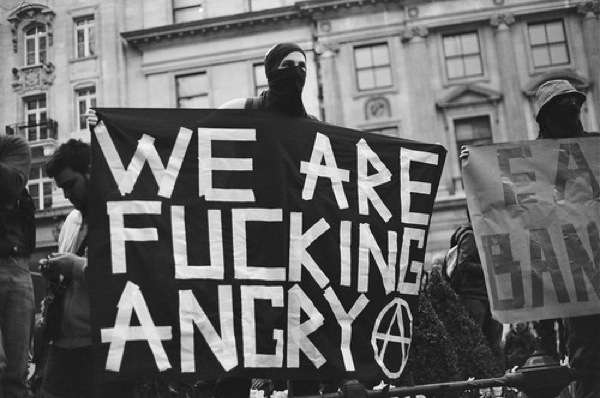
Occupy Everything and the Politics of the Act


Many people wonder what it is that these new 'occupy' protests can accomplish, and have trouble envisioning the so-called "ends" of the movement. But the beauty of what is happening is not found in the "ends", but the "means" that has been chosen. Politics is changing, and we can and should push it to be more localized.

Politics, as many of us are accustomed to thinking of it, usually boils down to what has been called the 'politics of demand'. The politics of demand can be understood as the coming together of three interlocking ideas


1. Asking someone else to solve something


A group with grievances ‘demands’ that a specific existing institution ‘fixes’ the problem, sometimes with minor input from the grieved group. This reinforces the authority and power of the institution in question, whether that institution is a corporation, government agency, or whatever else. *These institutions exist to silence these demands in any way they can that alters the status quo as little as possible* The more we ‘demand’ from them, the more we rely on them, and the more power they will have. It also has a tendency to hide, exacerbate, or multiply the source of those grievances.

2. Vertical organizing


In order for the aggrieved group to interact "efficiently" with authority, representatives are chosen and given negotiating powers, goal making powers, and general decision making abilities that are not afforded to the rest of the group. Internal power structures quickly form and become entrenched, keeping the large majority (99%, anyone?) from actually participating in anything but being a warm body at an event, or possibly a signature or a vote… anything but a meaningful and engaged participant.


3. Education before action


There is a very high tendency, in this normal mode of politics, to assume that everyone doesn't agree with (x) or doesn't know how to understand or do (x) correctly because they need someone to tell them what's "really wrong" with whatever…. which, when you think about it, is kind of insulting.


---


On the other side of the spectrum we have the Occupy Everything movement. Or, at least this is what I think makes Occupy so much more engaging than anything else that has happened in contemporary politics. These diffuse movements currently exemplify what has been called the 'politics of the act', which can also be understood as three interlocking ideas.


1. Acting without begging for permission


Instead of asking for an institution to solve some grievance, the aggrieved group acts in creative ways in order to begin solving it's own problems. This may lead to some ‘demands’ being met, but does not start from making ‘demands’, and therefor cannot be told to sit down and be quiet when (x) demand is supposedly met. Occupying wall street without a permit is a prime example of this. It is a beginning, a call out to those who would like to build something better. It comes down to the idea of building alternative (horizontal) networks to the obviously corrupt (vertical) system we have, without asking permission from that very system.

2. Horizontal organizing


Horizontal' refers to an idea of equality, that we should all be interacting on a level playing field, a horizon. So horizontal organizing is a reference to organizations that prioritize no particular personality, but allow for anyone to participate how they can, when they can. This creates a network that has no ‘leaders’, but where everyone is capable of acting in temporary leadership (spokesperson) roles. Equality in organizing. Once again, the way that the Occupy movement has been acting is a prime example of this, with the general assemblies, the human mic, and the generally 'open-source' type network building online and on the ground.


3. Equality of action


We are all equally alive, and have our own experiences, which do not negate the experiences of others. It is from these personal experiences that we must act, not from external commands or teachings. We are individuals. We all have the capacity to act, when and how we see fit, guided by our own experiences. These experiences are what have inspired thousands of people, many of whom had never bothered with a protest before or had given up, to come out and Occupy Everything. If we continue to act from our own experiences in this way, and build up an individualized yet communal experience of building and of resistance to corrupt systems, we can change everything, and we can do it ourselves.

The strength of the Occupy Everything movement so far is how closely it has generally stuck with the politics of the act and rejected the politics of demand. My hope in pointing this out is to add to and expand our collective experiences, hopefully in a way that pushes us farther and farther towards those better worlds, because other worlds truly are possible, as long as we act to make them. We are not asking for a new world. We are not demanding a new world. We are creating it.


Concepts that can be useful:


Self-Organization


Being forced into a group can certainly improve ones skills in some senses for some people, but nothing seems to work better than a group that simply seems to 'click', when people just decide to get together themselves, without being directed. No-one knows who you get along with and what you do better than yourself.


Free Association


Life is not static, and who we act and discuss with should not be either. Free association is the ability to freely enter and leave groups according to preference


Direct Action


When someone acts in order to further their ideas and goals without resorting to another group for mediation. Direct action simply refers to our capacity to act directly in achieving goals and resolving issues. It is an older and possibly narrower way of talking about the politics of the act 


Mutual Aid


Though many seem to think that we are inherently and strongly competitive, we are in fact what biologists call a 'social' species, we have evolved to work in groups. Competition, of course, occurs within and between the groups we form, but a high tendency for cooperation is what got us through most of the problems we've historically encountered as a species. Mutual aid refers to this capacity for cooperation with others, a capacity that we would be wise to act on.


Demand Nothing
Occupy Everything


text found: http://news.infoshop.org/article.php?story=20111025114601766 
photo-colaz found: http://friendsofibnfirnas.blogspot.com/ 
more info about Occupy Everything: http://occupyeverything.org/

April 4, 2009

Photovoltaic Cells in Prapopoulou Squat , Athens


With the installation of photovoltaic cells in Prapopoulou Squat Athens,
Greece starts an experiment of collective ownership and self-management of
energy sources willing to cover our energy needs
.

4 April
11:00: collectively installation of photovoltaic cells and sharing skills.
19:00: Self learning seminar of the function and installation of
photovoltaics cells

5 April
11:00: collectively installation of photovoltaic cells and sharing
skills(continue)
19:00: Update about copenghagen 2009 call for climate action by Farma
collective, conversation about radical ecology and green capitalism.

In the way for energy autonomy:
Capitalism has converted earth into a patient that can hardly brieth.
Renewable energy sources could give her some air only if their management
is done by the society for the society. Energy autonomy is one of the
fronts of the struggle for social liberation.

The capitalists are already exploiting the more environmentally friendly
solutions in order to gain more profit.

The same companies, statal and international organisations that destroy
our planet with fossil fuel and promote overconsumption in all over the
world, now wear a green mask and pretend to trully care for nature.

What we need is to realise that the ideology of exploitation of humans and
nature is what led to the environmental destruction and there is no way it
can prevent it.

Take renewable enrgy in our hands


The poster of the event:
http://athens.indymedia.org/calendar/event.php?id=17394

In english:

Prapopoulou squat:
http://protovouliaxalandriou.blogspot.com/2005/02/prapopoulou-squat-athens-greece.html

Farma collective
http://farmazapatista.blogspot.com
Related Posts Plugin for WordPress, Blogger...